
Home House Mice
Rodent Species Guide
House Mice: Identification, Characteristics, Habits and Signs
House mice (Mus musculus) are small, adaptable rodents commonly associated with homes, businesses, farms, and other buildings. They can live indoors or outdoors, but they are especially successful around people because buildings often provide food, water, warmth, and sheltered places to nest.
A house mouse may remain hidden for long periods, so its presence is not always obvious. Small dark droppings, gnaw marks, shredded nesting material, scratching sounds, and damaged food packaging can provide clues. Understanding these signs helps property owners recognize possible mouse activity and take steps to reduce the conditions that attract rodents.
This guide explains house mouse identification, physical characteristics, diet, nesting habits, reproduction, lifespan, common signs, health considerations, and prevention. It also explains how to distinguish a house mouse from a deer mouse, field mouse, or rat.
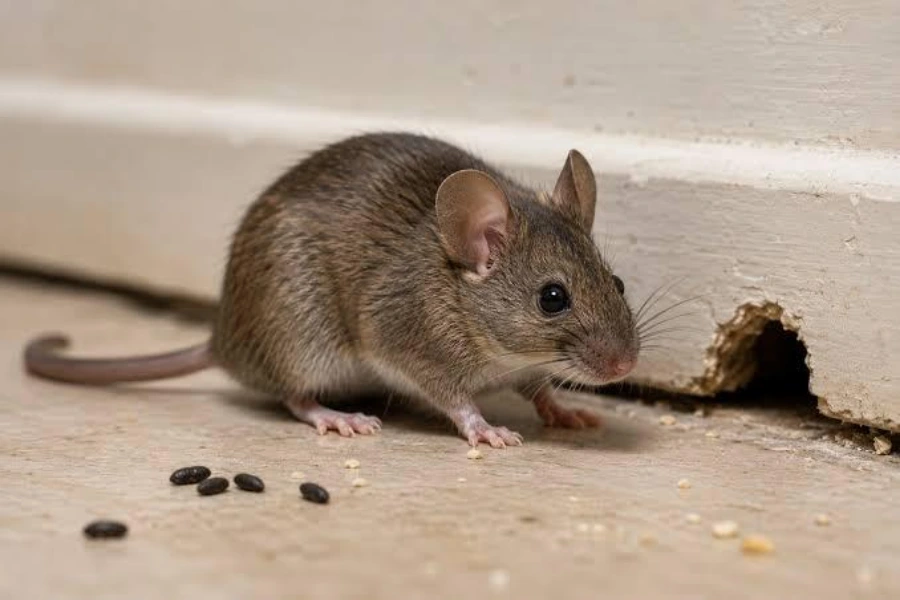
What Are House Mice?
The house mouse is a small mammal that belongs to the rodent order. Its scientific name is Mus musculus. It is widely distributed and often lives close to people, although it can also survive outdoors in suitable habitats.
House mice are opportunistic feeders. They consume a variety of foods, including grains, seeds, and food scraps. Their small bodies allow them to enter narrow openings, while their climbing and nesting abilities help them use spaces that people rarely check.
A house mouse does not need a large area to establish a nest. It may shelter behind appliances, inside cupboards, in storage boxes, within wall voids, or in other protected spaces near food.
House Mouse Scientific Classification
The house mouse belongs to the family Muridae, a large family of rodents that includes many mice and rats.
| Classification | Name |
|---|---|
| Common name | House mouse |
| Scientific name | Mus musculus |
| Kingdom | Animalia |
| Phylum | Chordata |
| Class | Mammalia |
| Order | Rodentia |
| Family | Muridae |
| Genus | Mus |
| Species | Mus musculus |
The name Mus musculus refers to the common house mouse. It is an introduced species in North America and is widely distributed across Texas, where it is commonly associated with human buildings and other developed environments.
What Do House Mice Look Like?
House mice are small rodents with relatively large ears, small dark eyes, a pointed muzzle, and a long, thin tail. Their fur is commonly light brown, grayish-brown, or gray. The underside may be somewhat lighter, but it generally does not have the sharply defined white belly associated with deer mice.
Their tails are mostly hairless or sparsely covered with fine hair. Unlike a typical deer mouse, a house mouse does not usually have a clearly divided dark upper tail and white lower tail.
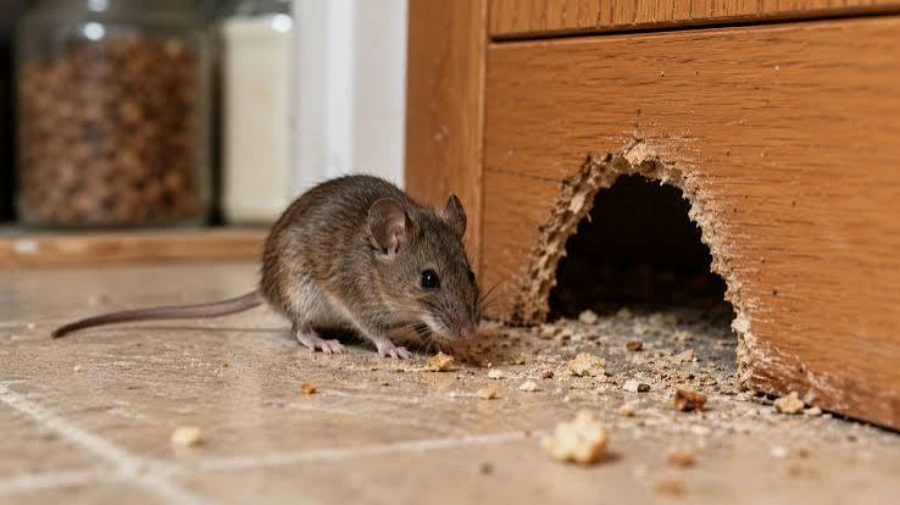
Common Identification Features
- Small, slender body.
- Light brown, gray, or grayish-brown fur.
- Relatively large ears.
- Small, dark eyes.
- Pointed nose and long whiskers.
- Long, thin tail with little visible fur.
- Small feet and a narrow body.
Colour can vary, so no single feature should be used to identify a mouse with complete certainty. A combination of body shape, fur pattern, tail appearance, and other signs provides a more useful indication.
House Mice Size and Body Characteristics
How big do house mice get?
An adult house mouse typically measures approximately 2.5 to 3.75 inches from its nose to the base of its tail. Its tail is commonly around 3 to 4 inches long. Including the tail, the total length is often approximately 5 to 7 inches.
Adult weight is commonly around half an ounce, although individual size varies.
| Physical characteristic | Typical description |
|---|---|
| Body length | Approximately 2.5–3.75 inches |
| Tail length | Approximately 3–4 inches |
| Total length | Approximately 5–7 inches |
| Adult weight | Around 0.5 ounce |
| Body shape | Small and slender |
| Fur | Brownish to gray |
| Tail | Long and mostly hairless |
These are general biological measurements, not a guaranteed identification test. Age, sex, and individual variation can affect size.
What Do House Mice Eat?
House mice are omnivorous and opportunistic. They commonly feed on seeds, grains, cereals, and other plant material, but they can also eat many foods found in homes.
Food sources may include:
- Rice, flour, cereal, and other dry goods.
- Seeds, nuts, and grains.
- Bread, biscuits, and food crumbs.
- Pet food and animal feed.
- Fruits and vegetables.
- Food scraps and accessible waste.
- Insects and other small food items.
What Does a House Mouse Eat in a Home?
Inside a property, available food may include unsealed pantry products, crumbs beneath appliances, pet food left in bowls, food waste, and items stored in thin packaging.
House mice often nibble small amounts from multiple food sources rather than consuming a large meal in one place. They may also carry food into a sheltered location.
Food contamination can occur when mice walk over, urinate on, or leave droppings near stored food and food-preparation surfaces. Store food in tightly sealed containers and discard food that may have been contaminated.
What Attracts House Mice to Homes?
A property may attract mice when it provides easy access to food, water, and shelter. Clutter and undisturbed storage areas can also create suitable nesting locations.
Common attractants include:
- Unsealed food packages and open pantry containers.
- Crumbs, grease, and food residue.
- Pet food left out for long periods.
- Uncovered rubbish and overflowing bins.
- Water leaks and accessible moisture.
- Cardboard, paper, fabric, and other nesting materials.
- Cluttered cupboards, garages, and storage rooms.
- Gaps around doors, pipes, cables, and building openings.
A house mouse does not necessarily enter because a property is dirty. Even a well-maintained building can have openings or accessible food sources that allow rodents inside.
Reducing food access and shelter can make a property less attractive, but these measures should be combined with attention to possible entry points.
Where Do House Mice Live and Hide?
House mice can live outdoors or indoors. Around buildings, they often remain close to food and nesting materials and use sheltered spaces to avoid people and predators.
Common Indoor Hiding Places
House mice may hide in:
- Kitchen cabinets and pantry spaces.
- Behind refrigerators, ovens, and washing machines.
- Inside cupboards and drawers.
- Wall voids and gaps around plumbing.
- Behind stored boxes and furniture.
- Attics, garages, and utility rooms.
- Suspended ceilings and other concealed spaces.
- Upholstered furniture or stored materials.
Outdoor Habitats
Outside, house mice may use dense vegetation, grassy areas, sheds, storage buildings, agricultural fields, and sheltered spaces near structures.
In Texas, the species is widely distributed and is often found in close association with people. It may also occur in vegetation and other suitable outdoor habitats.
House Mouse Nests: Where Do They Build Them?
A house mouse nest is usually a small, sheltered structure made from soft, shredded materials. Mice may use paper, cardboard, fabric, insulation, dried plant material, and other fibres to create a protected nesting space.
Nests are commonly located near food sources and in places with little disturbance.
Possible nesting locations include:
- Behind kitchen cabinets and appliances.
- Inside wall or ceiling voids.
- In attics and garages.
- Within stored cardboard boxes.
- Inside upholstered furniture.
- Under piles of paper or fabric.
- In storage areas and outbuildings.
A nest may be difficult to see because mice often build it inside an enclosed or concealed space. Shredded material, droppings, and repeated activity in the same area may indicate a nearby nesting location.
How Do House Mice Get Into a House?
House mice can enter buildings through surprisingly small openings. An opening approximately one-quarter of an inch wide may be large enough for a mouse to squeeze through.
Potential entry points include:
- Gaps beneath exterior doors.
- Cracks around foundations and walls.
- Openings around water pipes and drain lines.
- Gaps around electrical cables and utility connections.
- Damaged window screens.
- Roofline and ventilation openings.
- Openings around garage doors.
- Gaps where building materials meet.
Mice can also climb rough surfaces, wires, cables, vegetation, and other structures to reach higher openings.
Why Small Gaps Matter
A small opening may be difficult to notice during an ordinary walk around a property. Check areas where utility lines enter the building, door edges, damaged screens, and gaps around exterior fixtures.
For a preliminary checklist of possible access areas, visitors can use the Rodent Entry Point Checker.
The tool is a self-assessment tool, not a physical inspection or confirmation that a mouse is using a particular opening.
House Mice Droppings: Identification and Appearance
House mouse droppings are among the most recognizable signs of possible mouse activity. They are generally small, dark, smooth, and shaped like narrow grains of rice. A dropping may have one or both ends tapered.
Typical house mouse droppings are approximately one-eighth to one-quarter of an inch long, although size and appearance can vary.
Where Are Mouse Droppings Commonly Found?
Look for droppings in places where mice feed, travel, or shelter, including:
- Kitchen cupboards and drawers.
- Pantry shelves and food-storage areas.
- Behind refrigerators and other appliances.
- Under sinks.
- Along walls and behind stored items.
- In garages, attics, and storage spaces.
- Near nesting material or suspected entry points.
How Can You Recognize Possible Mouse Droppings?
Common characteristics include:
- Small, dark pellets.
- Narrow or rice-like shape.
- Smooth surface.
- One or more tapered ends.
- Repeated deposits along sheltered routes.
Droppings alone cannot confirm the exact rodent species or establish whether an infestation is currently active. Other rodents and some insects can leave waste that may be confused with mouse droppings.
Important cleanup precaution: Do not touch, sweep, or vacuum suspected rodent droppings while dry. The CDC advises wetting rodent waste with an appropriate disinfectant before wiping it up, using gloves, and following its detailed cleanup guidance. For larger accumulations or extensive contamination, seek appropriate professional guidance.
When Are House Mice Most Active?
House mice are mainly nocturnal, meaning they are generally more active during the night. They often move around when people are less active and the property is quieter.
However, nocturnal does not mean they only move at night. House mice may also be active during the day, particularly when food is available or their normal activity patterns are disturbed.
When Do House Mice Come Out?
Mice may leave hiding places to search for food, water, and nesting materials. They often follow familiar routes along walls, behind objects, and through concealed spaces.
If a mouse is seen during daylight, it does not automatically prove that the infestation is severe. Repeated sightings, fresh droppings, gnawing, or other signs should be considered together.
Can House Mice Climb Walls and Jump?
Yes. House mice are capable climbers and can move across many rough or textured surfaces. They can climb wood, brick, rough concrete, wires, cables, ropes, and vegetation.
Smooth surfaces may be more difficult to climb, but the surrounding structure can provide alternative routes.
Can House Mice Jump?
House mice can jump onto raised surfaces. University of California IPM reports that they can jump up to approximately 12 inches from the floor onto a flat surface. Other extension references report different measurements, so jumping ability should be treated as an approximate capability rather than a fixed limit.
How High Can House Mice Jump?
A jump of around 12 inches is a useful general reference from UC IPM, but actual performance may vary with the surface, starting position, and individual mouse.
Their ability to climb and squeeze through small openings means that checking only floor-level gaps is not enough. Higher openings around utility lines, vegetation, and building connections may also deserve attention.
House Mice Sounds: Squeaking, Scratching, and Movement
House mice can make high-pitched squeaks and other sounds. People may also hear movement as mice travel through concealed spaces.
Possible sounds include:
- Short, high-pitched squeaks.
- Scratching inside walls or ceilings.
- Scurrying or light movement above ceilings.
- Gnawing sounds.
- Rustling in cupboards or stored materials.
Why Do House Mice Squeak?
Mice use vocalizations for communication and social interaction. Some sounds are very high-pitched and may be difficult for people to hear.
Not every scratching or squeaking noise indicates mice. Other animals, building materials, plumbing, and ventilation systems can produce similar sounds. Look for supporting evidence such as droppings, gnaw marks, or nesting material.
House Mice Reproduction and Life Cycle
House mice have a high reproductive potential, particularly when food and shelter are readily available. They can reproduce throughout the year in suitable indoor conditions.
A female house mouse may produce several litters in a year. UC IPM reports that females may have approximately five to ten litters annually, commonly with around five or six young per litter. Actual reproduction varies with food availability, age, health, environmental conditions, and other factors.
How Quickly Do House Mice Reproduce?
Pregnancy generally lasts about 18 to 21 days. Newborn mice are small and dependent on their mother. They develop rapidly, and young mice may become sexually mature at approximately five to six weeks, although maturity can be delayed.
Because young mice can reach reproductive age quickly, a small population may grow if suitable food, water, shelter, and access remain available.
How Long Do House Mice Live?
The typical house mouse lifespan is relatively short. UC IPM reports that house mice commonly live around nine to twelve months, although some individuals may survive for up to three years.
Lifespan depends on several factors, including:
- Food and water availability.
- Disease and parasites.
- Predation.
- Environmental conditions.
- Human control measures.
- Access to safe nesting areas.
A mouse living inside a protected building may experience different conditions from one living outdoors. The lifespan of an individual mouse should not be confused with the duration of a mouse population inside a property.
House Mice in Winter
House mice remain active throughout the year. When outdoor temperatures become colder, mice living near buildings may seek shelter indoors, especially where food and protected nesting spaces are available.
However, house mice are not exclusively winter pests. Indoor populations can remain active in every season when conditions are suitable.
To reduce the chance of mice entering during colder periods:
- Seal gaps around doors and utility lines.
- Repair damaged screens.
- Store food in tightly closed containers.
- Reduce clutter around buildings.
- Keep rubbish containers covered.
- Check garages, storage areas, and other sheltered spaces for signs of activity.
Signs of a House Mice Infestation
A house mouse may remain hidden, but repeated activity can leave visible evidence. No single sign proves the size of a population. Several signs in the same area provide stronger evidence of rodent activity.
- Small Dark Droppings — Droppings may appear in cupboards, drawers, food-storage areas, and along sheltered routes.
- Gnaw Marks — Mice gnaw on packaging and other materials. Look for small bite marks on food containers, cardboard, wood, and other accessible objects.
- Shredded Nesting Material — Torn paper, fabric, cardboard, and insulation may indicate that mice are collecting material for a nest.
- Scratching and Movement Sounds — Scratching, scurrying, or squeaking may be heard in walls, ceilings, cupboards, and other concealed spaces.
- Damaged Food Packaging — Small holes or torn edges in food packages may indicate rodent access. Check nearby shelves and storage spaces for droppings as well.
- Unusual Musky Odour — A persistent musky smell may develop where mouse activity has continued, particularly in enclosed or poorly ventilated spaces.
- Tracks and Rub Marks — Mice may leave footprints on dusty surfaces. Repeated travel along a route can also leave faint marks where their bodies contact walls or other surfaces.
- Sightings — Seeing a mouse is direct evidence that one is present, but it does not reveal how many may be hidden elsewhere.
If signs keep appearing after an area has been safely cleaned, further investigation may be appropriate. The CDC explains that fresh droppings after cleanup can indicate continuing rodent activity.
Are House Mice Dangerous?
House mice can create health, hygiene, and property concerns. Their presence does not mean that a person will become ill, but rodents can contaminate food and surfaces through droppings, urine, and saliva.
Potential concerns include:
- Food contamination: Mice may contaminate food and food-preparation areas.
- Pathogen exposure: Rodents can carry organisms that may cause illness in people.
- Bites and scratches: A mouse may bite if handled, trapped, or threatened.
- Property damage: Gnawing can damage packaging, stored materials, and some building components.
- Electrical and equipment concerns: Rodent chewing may damage wiring and other components.
Can House Mice Spread Disease?
Rodents can spread disease through direct contact or exposure to contaminated materials. The specific risk depends on the rodent species, the pathogen, the location, and the type of exposure.
See the rodent diseases hub for the specific illnesses and how exposure happens.
It is important not to confuse house mice with deer mice when discussing hantavirus. In the United States, hantavirus pulmonary syndrome is primarily associated with exposure to infected deer mice and certain other wild rodents. Do not assume that every house mouse carries hantavirus.
Avoid touching wild rodents, their droppings, urine, or nesting materials. Follow public-health cleanup guidance when rodent waste is present.
House Mice vs. Deer Mice
House mice and deer mice can look similar at first glance, but several physical characteristics can help distinguish them.
Deer mice belong to the genus Peromyscus. They are generally associated with outdoor habitats such as fields, grasslands, and wooded areas, although they may enter buildings.
Difference Between House Mice and Deer Mice
| Feature | House mouse | Deer mouse |
|---|---|---|
| Scientific name | Mus musculus | Commonly Peromyscus maniculatus |
| Typical body colour | Grayish-brown or brown | Brown to reddish-brown or gray |
| Belly | Usually similar in tone to the body or somewhat lighter | Usually distinctly white |
| Tail | Mostly hairless or sparsely furred | Furred and usually two-toned |
| Tail underside | Not sharply separated into white and dark colours | Commonly pale or white underneath |
| Eyes | Relatively small | Often noticeably larger |
| Common habitat | Buildings and areas close to people; also outdoor habitats | Fields, grasslands, wooded areas, and other outdoor habitats |
| Important health distinction | Do not assume it carries hantavirus | Certain deer mice can carry hantaviruses |
The clearest visual difference is often the deer mouse’s white underside and two-toned tail. House mice generally have a more uniform gray-brown appearance and a less furry tail.
Why Correct Identification Matters
Some wild mice, including deer mice, are associated with hantavirus transmission in the United States. If a mouse cannot be confidently identified, avoid handling it and use safe rodent precautions.
House Mice vs. Field Mice
The phrase “field mouse” is a common name rather than one precise scientific identification. People may use it for different wild mouse species depending on their region.
In some contexts, the term refers to deer mice or other members of the genus Peromyscus. Other small wild rodents may also be called field mice in everyday conversation.
For this reason, a field mouse should not automatically be treated as a separate, clearly defined species.
Difference Between House Mice and Field Mice
| Feature | House mouse | Field mouse (common name) |
|---|---|---|
| Scientific identity | Mus musculus | Depends on the region and species meant |
| Typical habitat | Buildings, homes, farms, and outdoor habitats | Often fields, grassland, vegetation, or woodland edges |
| Fur pattern | Commonly grayish-brown and relatively uniform | May have a brown back and lighter or white underside |
| Tail | Mostly hairless or sparsely furred | Often more visibly furred; pattern varies by species |
| Relationship with buildings | Frequently lives close to people | May enter buildings when shelter or food is available |
| Identification | Can be identified by a combination of body and tail features | Requires identification of the actual species |
If a mouse has a sharply contrasting white belly and a distinctly two-toned tail, it may be a deer mouse or a related wild species rather than a typical house mouse. A photograph or professional identification may be needed for certainty.
House Mice vs. Rats
House mice are much smaller than adult Norway rats and roof rats. Size, body shape, tail proportions, and droppings can help distinguish them.
| Feature | House mouse | Norway rat | Roof rat |
|---|---|---|---|
| General size | Small and slender | Larger and stockier | Larger and more slender than a Norway rat |
| Muzzle | Pointed | Blunter | Pointed |
| Ears | Relatively large for body size | Smaller relative to body | Prominent |
| Tail | Long, thin, mostly hairless | Usually shorter than head-and-body length | Usually longer than head-and-body length |
| Common nesting areas | Cabinets, wall voids, stored materials, and sheltered spaces | Often ground-level burrows and lower areas | Often elevated spaces such as attics and trees |
| Droppings | Small, narrow pellets | Larger and thicker | Larger than typical mouse droppings |
For more detailed identification, read the guides to Norway rats and roof rats.
House Mice Prevention
Prevention focuses on reducing access to food, water, shelter, and entry points. No single housekeeping measure can guarantee that mice will never enter a building, but consistent preventive steps can make a property less attractive and reduce opportunities for access.
- Store Food Securely — Keep grains, cereals, pet food, and other food products in tightly sealed containers. Avoid leaving food packages open or accessible overnight.
- Maintain Clean Food-Preparation Areas — Clean crumbs, food residue, and grease from counters, floors, cupboards, and areas beneath appliances. Empty rubbish regularly and use covered bins.
- Reduce Clutter — Cardboard, paper, fabric, and stored materials can provide shelter and nesting material. Keep storage areas organized and avoid leaving piles undisturbed for long periods.
- Seal Small Openings — Check gaps around pipes, cables, doors, windows, foundations, and utility connections. House mice may enter through openings around one-quarter of an inch wide. Use suitable rodent-resistant materials for repairs. Foam or soft materials alone may not provide durable protection against gnawing.
- Check Doors and Screens — Repair damaged screens and install suitable door sweeps or weatherstripping where gaps exist. Pay particular attention to garage doors and other frequently used entrances.
- Manage Outdoor Vegetation and Storage — Keep dense vegetation and unnecessary stored materials from creating sheltered routes close to buildings. Organize outdoor storage and keep rubbish containers closed.
- Check Vulnerable Areas Regularly — Look around pantry shelves, cupboards, garages, attics, utility areas, and spaces where pipes or cables enter the building. Early recognition of droppings or gnaw marks can help identify a problem before activity becomes more established.
Professional Mouse Control: When to Seek Assistance
Basic prevention may reduce the conditions that attract mice, but repeated signs can indicate that rodents have access to concealed areas or that entry points remain open.
Consider seeking assistance from an appropriately qualified pest-control provider when:
- Droppings continue to appear after safe cleanup.
- Mice are repeatedly seen inside the property.
- Scratching or movement sounds continue in walls or ceilings.
- Food packaging or stored materials are repeatedly damaged.
- You suspect nesting inside wall voids, ceilings, or other inaccessible areas.
- Rodent waste is extensive or contamination affects insulation or ventilation systems.
A suitable provider can discuss identification, the possible extent of activity, control options, entry-point management, and any necessary cleanup. Confirm the provider’s qualifications, service area, availability, pricing, and scope directly before arranging work.
For information about professional options in the Houston area, visit the Mice Removal Houston service page.
For information about reducing possible access points, see Rodent Exclusion in Houston.
Important website disclosure: This website is an enquiry and connection resource. Independent service providers—not this website—perform inspections, treatments, removal, exclusion, and related work. Service availability and scope must be confirmed directly with the provider.
Looking for Information About Mouse Control in Houston?
If you are researching professional options for a mouse problem in the Houston area, visit our mice removal information page. Independent service providers perform the actual inspections and pest-control work. Confirm service availability, qualifications, pricing, and scope directly with the provider.
Frequently Asked Questions About House Mice
What does a house mouse look like?
A house mouse is a small, slender rodent with grayish-brown or light brown fur, relatively large ears, small dark eyes, a pointed muzzle, and a long, thin tail. Its tail is mostly hairless or sparsely covered with fine hair.
What do house mice eat?
House mice eat grains, seeds, cereals, food scraps, pet food, and many other available foods. They are opportunistic feeders and may nibble small amounts from several food sources.
Where do house mice live and hide?
House mice live indoors and outdoors. Inside buildings, they may hide behind appliances, inside cupboards, in wall voids, attics, garages, storage boxes, and upholstered furniture. Outdoors, they may shelter in vegetation and other protected spaces.
How do house mice get inside a house?
They can enter through small gaps around doors, windows, foundations, pipes, cables, and utility connections. An opening around one-quarter of an inch wide may be enough for a house mouse to squeeze through.
How big do house mice get?
An adult house mouse commonly has a body length of about 2.5 to 3.75 inches and a tail around 3 to 4 inches long. Its total length, including the tail, is often approximately 5 to 7 inches.
How long do house mice live?
House mice commonly live around nine to twelve months, although some individuals may survive for up to three years. Lifespan depends on food, shelter, disease, predators, and environmental conditions.
Are house mice nocturnal?
Yes. House mice are mainly nocturnal and are generally more active at night. However, they can also move around during daylight, particularly when food is available or their normal activity is disturbed.
Can house mice climb walls?
House mice can climb many rough or textured surfaces, including wood, brick, rough concrete, wires, cables, and vegetation. Smooth surfaces may be more difficult for them to climb.
How high can house mice jump?
UC IPM reports that house mice can jump up to approximately 12 inches from the floor onto a flat surface. Their actual jumping ability may vary depending on the surface and circumstances.
What do house mouse droppings look like?
House mouse droppings are usually small, dark, smooth, and shaped like narrow grains of rice, often with tapered ends. They are commonly around one-eighth to one-quarter of an inch long. Do not touch, sweep, or vacuum dry rodent droppings.
What attracts house mice to a property?
Accessible food, water, shelter, and nesting materials can attract house mice. Open food packages, pet food, rubbish, crumbs, clutter, and gaps in a building can all contribute to conditions that allow mouse activity.
Where do house mice build their nests?
They build small nests in sheltered spaces near food and other resources. Common locations include cupboards, wall voids, attics, garages, storage boxes, furniture, and areas containing shredded paper, fabric, or insulation.
How quickly do house mice reproduce?
Pregnancy usually lasts around 18 to 21 days. Females may produce several litters in a year, and young mice can reach sexual maturity at approximately five to six weeks, although this varies with conditions.
Do house mice bite humans?
House mice can bite if they are handled, trapped, or feel threatened. Avoid picking up wild mice with bare hands. If a bite occurs, wash the wound promptly and seek medical advice about appropriate care.
What is the difference between house mice and deer mice?
House mice usually have a more uniform gray-brown coat and a mostly hairless tail. Deer mice commonly have a white belly, larger eyes, and a furry, two-toned tail. Deer mice are also important to distinguish because certain populations can carry hantaviruses.
What is the difference between house mice and field mice?
“Field mouse” is a common name that can refer to different wild mouse species. Some have a brown back, white underside, and more visibly furred tail, while house mice are commonly gray-brown with a less furry tail. Correct identification depends on the actual species and region.
Are house mice dangerous to humans?
They can create health and property concerns by contaminating food and surfaces with droppings, urine, or saliva, and by gnawing on materials. Rodents can carry pathogens, but the specific disease risk depends on the species and exposure. Avoid direct contact and follow public-health guidance for safe cleanup.
Further Reading and Sources
The following authoritative references were used as background for this guide.
- University of California IPM — House Mouse
- University of California IPM — Deer Mouse
- CDC — How to Clean Up After Rodents
- CDC — Hantavirus Prevention
- Texas A&M AgriLife Extension — Managing Rats and Mice
- National Park Service — Conserve O Gram 3/12: Identifying Mouse and Rat Damage in Museum Collections